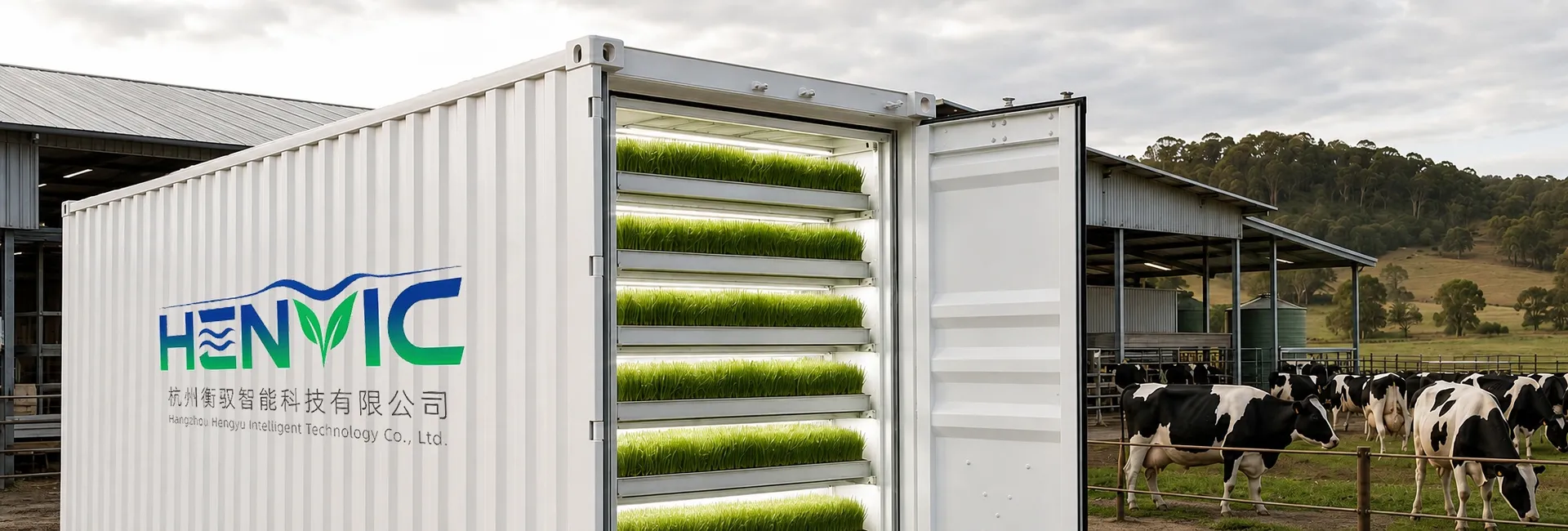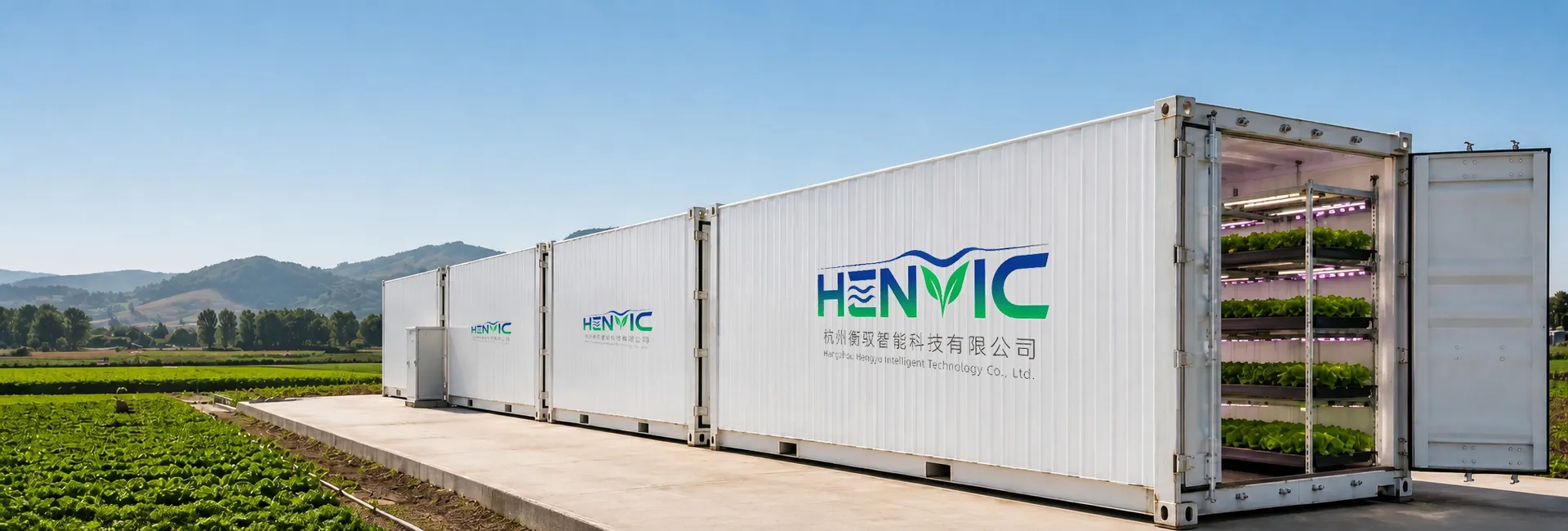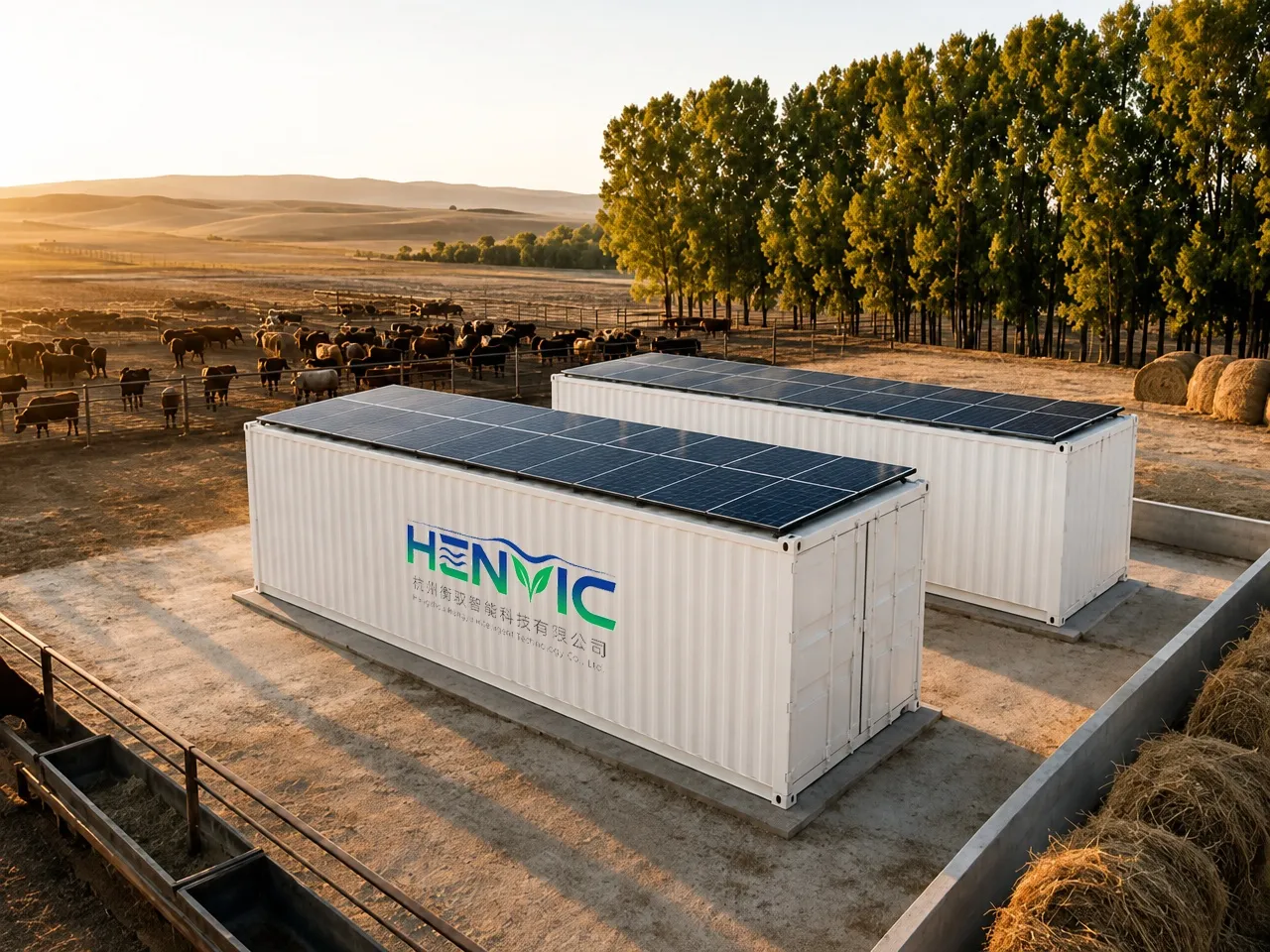
Temperature control is the single largest operating cost in most container farms, and the choice of cooling architecture is the decision that locks that cost in for the life of the unit. Three broad approaches dominate the conversation — air cooling, water cooling, and heat pumps — and they are often presented as competing technologies to be ranked. That framing misleads. They operate at different points in the same thermal system, and the real question is not which one is best but how they are combined, and against what external climate the combination has to hold.
Why temperature control is the hard problem
A container farm is a sealed steel box with a high surface-area-to-volume ratio. That geometry cuts both ways. It decouples the crop from the weather — a desert afternoon and a polar night both resolve to the same internal setpoint — but it also means the envelope loses and gains heat faster than a larger, better-insulated building would. Every photon of light is artificial, and LEDs convert only a fraction of their input power into usable photons; the rest becomes heat that must be removed. Add the latent load from crop transpiration, the heat from pumps, fans, and controllers, and the cooling system is carrying a continuous, non-negotiable burden.
The load breaks into two parts, and confusing them is the source of most design errors. Sensible load is heat that raises air temperature. Latent load is the energy tied up in water vapor, released when that vapor condenses. In a sealed container, transpiration keeps pumping moisture into the air, and dehumidification is inseparable from cooling — you cannot manage temperature without managing humidity, because condensing water vapor is how most systems remove it.
Air cooling: simple, direct, and load-bound
Air cooling is the default for small and medium container farms. Refrigerant circulates through an evaporator coil; fans push container air across the coil; heat moves from air to refrigerant and is rejected outside through a condenser. It is cheap to install, easy to service, and well understood.
Its advantages are real. It requires no secondary fluid loop, no plumbing beyond the refrigerant circuit, and no freeze protection. A single packaged unit can serve a small container. Controls are straightforward, and replacement parts are commodity items.
Its limitations are equally real. Air is a poor heat-transfer medium — low density, low specific heat, low thermal conductivity — so moving enough heat requires large volumetric flow. Those fans consume power and generate their own heat, and they create the airflow patterns that dry out leaf surfaces unevenly and can stress plants near outlets. Air cooling also struggles to hold tight tolerances across a large volume: temperature stratification develops, and the difference between the top and bottom of a rack of plants can be several degrees unless airflow is carefully engineered.
The deeper constraint is the coupling of sensible and latent load. When the coil runs cold enough to condense moisture, it removes latent heat effectively — but it also overcools the air, requiring reheating to hold the setpoint, which wastes energy. When the coil runs warm enough to avoid overcooling, dehumidification suffers and humidity climbs. Air cooling forces a compromise between temperature precision and humidity control, and that compromise is the main reason larger facilities move beyond it.
Water cooling: better heat transfer, more complexity
Water cooling uses a liquid — typically chilled water or a water-glycol mixture — as the heat-transfer medium instead of air. A central chiller produces chilled fluid, which is circulated to air-handling units, fan coils, or radiant panels inside the container. The fluid absorbs heat from the air or directly from the growing zone, then returns to the chiller to be re-cooled.
The physics favors water decisively. Water's volumetric heat capacity is roughly 3,300 times that of air, and its thermal conductivity is far higher. That means much smaller flow rates and much smaller pipes can carry the same heat load, which in turn means less fan power, less noise, and less parasitic heat. Chilled-water systems can hold tighter temperature tolerances across a larger facility and can zone climate control more precisely — different rows or tiers can receive different conditions.
Water cooling also decouples the cooling source from the point of use. The chiller can sit outside the container, rejecting heat to ambient air, to a cooling tower, to a ground loop, or to a district system. That flexibility matters in dense urban installations where outdoor space and noise limits are real constraints.
The costs are complexity and failure modes. A chilled-water loop needs pumps, expansion tanks, valves, controls, and freeze protection in cold climates. Glycol concentration must be maintained. Leaks inside the container are a serious risk — water and electrical equipment do not mix, and a leak in a growing space can destroy a crop and damage infrastructure. Maintenance requires more skill than swapping a packaged air conditioner. And the chiller itself still has to reject heat somewhere, so the ultimate question of where the heat goes is deferred, not eliminated.
Water cooling is therefore the choice when the load is large, the tolerance is tight, or the heat rejection needs to be centralized. It is over-engineering for a single small container in a temperate climate.
Heat pumps: moving heat instead of dumping it
Heat pumps change the terms of the problem. Rather than treating heat as waste to be rejected, they treat it as a resource to be moved. A heat pump uses a refrigerant cycle to extract heat from one place and deliver it to another at a higher temperature, and its key advantage is that it can deliver more thermal energy than the electrical energy it consumes.
In a container farm, the heat pump's value lies in the fact that the facility has simultaneous, opposing thermal demands. The growing zone needs cooling — LEDs, transpiration, and equipment dump heat into it continuously. Somewhere else in the process, there is often a need for heat: pre-warming irrigation water, warming nutrient solution, heating a germination or seedling area, heating a post-harvest drying or processing space, or supplying hot water for sanitation.
A heat pump that captures the container's rejected heat and upgrades it to serve those demands turns a waste stream into a supply. In effect, it changes the energy accounting: instead of paying once to remove heat and again to add it elsewhere, the facility pays once and moves the same energy to where it is needed.
The concept extends further with heat recovery and thermal storage. Rejected heat can be stored in a water tank or phase-change material and drawn on later, which allows the cooling system to run when electricity is cheap and deliver heat when it is needed. In some designs, the same refrigeration circuit that chills the growing zone supplies the compressor heat to a thermal store, and the two are managed as a single system.
Heat pumps have their own constraints. Their efficiency depends on the temperature differential they have to bridge: the wider the gap between source and delivery temperature, the lower the coefficient of performance. In very cold climates, air-source heat pumps lose capacity and efficiency as ambient temperature drops, though low-temperature and cascade designs mitigate this. Capital cost is higher than a simple air-cooled chiller, and the system is more complex — valves, reversing capability, storage, and controls all add failure points. The economics only work when there is a genuine concurrent heat demand to serve; a heat pump with nothing to do with its recovered heat is just an expensive air conditioner.
Comparing the three on the dimensions that matter
Precision. Air cooling holds moderate tolerances across a single zone. Water cooling holds tighter tolerances and supports zoning. Heat pumps do not directly change precision — they change where the energy goes — but they pair well with chilled-water distribution because both operate on fluid loops.
Efficiency. Air cooling is the least efficient per unit of heat moved, largely because of fan power and the sensible-latent coupling. Water cooling is more efficient at the distribution stage but still relies on a chiller that rejects heat. Heat pumps are most efficient at the system level when recovery is used, because they reduce total energy purchased rather than merely moving it more cheaply.
Complexity and maintenance. Air cooling is simplest. Water cooling adds a second loop, pumps, and leak risk. Heat pumps add the most complexity: reversing circuits, storage, and integrated controls.
Climate dependence. Air cooling is most vulnerable to extreme ambient conditions, because rejection capacity shrinks as outside temperature rises. Water cooling shifts the burden to the chiller or cooling tower, which can be sized for the climate. Heat pumps are most climate-sensitive at low ambient temperatures for heating duty, but this is exactly where recovering internal heat is most valuable — the container produces heat regardless of the weather outside.
Footprint and noise. Air cooling consumes internal volume for air handling and produces continuous fan noise. Water cooling centralizes the noisy equipment outside. Heat pumps typically follow the same logic: keep the compressor and heat rejection outside the growing space.
How the choice maps to climate and scale
The right combination depends on two variables: the external climate and the scale of the facility.
In temperate climates with small facilities, air cooling is usually sufficient and cheapest. A packaged unit, careful airflow design, and attention to the sensible-latent balance will hold leafy greens and herbs adequately. The main risk is under-sizing for summer peaks.
In hot climates, air cooling's rejection capacity degrades exactly when demand is highest, and fan power climbs. Water cooling with an appropriately sized chiller or cooling tower is more robust, and heat recovery may be less useful because there is less concurrent heating demand — though pre-cooling irrigation water or supplying hot water for sanitation can still absorb recovered heat. Solar-assisted systems, pairing photovoltaic generation with the cooling load, are increasingly common because peak cooling coincides with peak generation.
In cold climates, the internal heat load becomes an asset. A container farm in a polar or high-latitude setting generates continuous waste heat while also needing heat for water, sanitation, and sometimes space conditioning. A heat pump with thermal storage converts what would be a doubling of energy cost into a single, partially recovered expense. This is where heat pumps deliver the largest advantage, and it is also where the technology has attracted the most attention in remote installations.
In large facilities, water cooling with centralized chillers and heat recovery becomes the norm, because the distribution efficiency gains compound with scale and the complexity cost is amortized. Air cooling loses viability as zone count and tolerance requirements rise.
The layered answer
The most defensible conclusion is that these are not alternatives but layers. Heat is generated inside the container; it must be collected, transported, and either rejected or reused. Air is often the medium that collects it from the growing zone, water is the medium that transports it efficiently, and a heat pump is the device that decides whether the collected energy is thrown away or put to work.
Designing temperature control well therefore means asking a sequence of questions rather than picking a favorite technology. How much heat does the facility actually generate, and how much of that is latent? What external climate must the system reject heat into, and how does that capacity vary seasonally? Is there a concurrent heat demand that recovered energy can serve, and is it large enough to justify the added complexity? What tolerance does the crop require, and across how many independently controlled zones? And what happens when the primary system fails — because in a sealed box, failure is measured in hours, not days.
The container's sealed envelope is what makes precise temperature control possible; it is also what makes the cooling system non-optional. The trade-off is not between air, water, and heat pumps. It is between paying to reject heat and being paid to reuse it — and the climate, the scale, and the crop economics decide which side of that line a given farm falls on.