1. Introduction
Mushrooms are approximately 90% water, and their fruiting bodies form only when temperature, humidity, and air quality simultaneously reach narrow, species-specific windows. In a heated indoor room, relative humidity typically falls to 40–50% — far below what most cultivated fungi require — which is why dedicated cultivation chambers have become the core equipment of both hobbyist and commercial mushroom farming. A well-designed cultivation chamber is essentially a climate-controlled nursery that recreates the post-rain, fresh-air microclimate in which mushrooms fruit in nature, decoupling production from season and climate.
2. The Four Governing Environmental Parameters
2.1 Relative Humidity
Most cultivated species fruit at 80–95% relative humidity (RH). This is the single most demanding parameter: fruiting bodies lose turgor and abort pins when RH drops, while stagnant, over-saturated air invites bacterial blotch and mould. Chamber design therefore centers on humidification capacity (ultrasonic humidifiers, misting systems, or evaporative reservoirs such as damp perlite) paired with hygrometers and humidistat controllers for closed-loop regulation.
2.2 Temperature
Temperature governs both mycelial colonization speed and fruiting initiation. Species differ sharply, so chambers must be zoned or run per-species:
| Species | Fruiting temperature | Humidity | Notes |
|---|---|---|---|
| Grey/Blue Oyster (Pleurotus ostreatus) | 10–20 °C | 80–95% | Cold-tolerant, beginner-friendly, highest home yields |
| Pink Oyster (Pleurotus djamor) | 21–29 °C (70–85 °F) | 85–95% | Fast: 3–5 days from pin to harvest; must be checked daily |
| Shiitake (Lentinula edodes) | 12–20 °C | High | Hardwood logs/blocks; months to first fruiting, long-lived |
| Button / Portobello (Agaricus bisporus) | 12–16 °C (53–60 °F) | 85–90% | Compost substrate; demands precise control and is prone to green mould |
| Lion's Mane (Hericium erinaceus) | 15–24 °C | Very high | Hardwood sawdust blocks; best in warm months or heated chambers |
2.3 Fresh Air Exchange and CO₂
Fungi respire heavily, and CO₂ accumulation is the classic cause of elongated, spindly stems and aborted caps. During fruiting, chambers must deliver constant fresh air; during colonization, mycelium tolerates (and benefits from) elevated CO₂, which suppresses contaminants and directs growth into the substrate. Chamber designs exploit this two-phase requirement: tight, unventilated conditions for incubation, then aggressive exchange for fruiting.
2.4 Light
Unlike plants, mushrooms do not photosynthesize. Direct sunlight harms them; low or indirect light (fluorescent or equivalent) is sufficient for normal fruiting development and harvest visibility.
3. Chamber Architectures
Shotgun Fruiting Chamber (SGFC). The benchmark low-cost design: a 50–90 L clear plastic tub drilled with 1/4-inch holes every 2 inches on all six sides, floor lined with 4–5 inches of damp perlite, and substrate elevated on a wire rack. It works on passive physics — cooler fresh air sinks through bottom holes, picks up moisture, warms, rises, and carries CO₂ out through the top. No fans or timers are required; maintenance is misting and fanning 2–4 times daily plus a weekly perlite moisture check (damp like "morning grass," never dripping).
Monotub and humidity tents. High-humidity, low-maintenance variants using thicker polypropylene and reduced ventilation ports to sustain 90%+ RH with less frequent intervention. Plastic humidity tents draped over blocks or cold-frame enclosures create the same effect as micro-climates inside larger rooms.
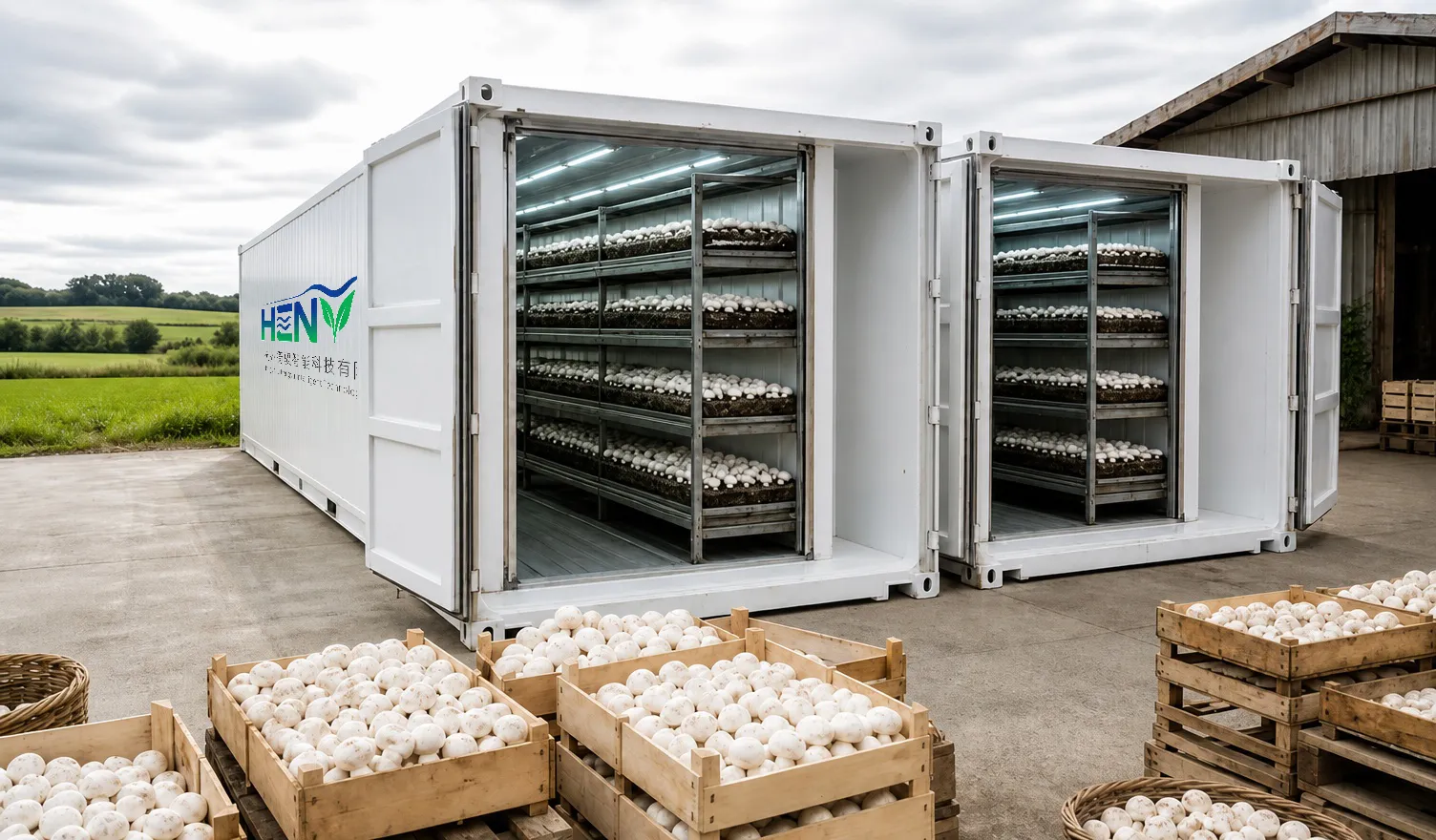
Active climate chambers (grow tents/rooms). Zip-style grow tents or insulated rooms paired with ultrasonic humidifiers, oscillating fans, CO₂ monitors, and programmable controllers (humidistats, timers) approximate commercial HVAC behavior at benchtop scale. Insulated spaces with multi-tier shelving maximize volume per square metre while allowing per-zone climate control.
Greenhouse and commercial-scale rooms. Shaded greenhouse benches or dedicated grow rooms provide natural humidity buffering (glass holds 3–5 °C of night-time heat), with two-stage workflows — dark incubation in a potting shed or conditioned room, then transfer to the humid fruiting zone. Industrial facilities scale this pattern with dedicated HVAC, fresh-air handling units, and HEPA-grade filtration for spawn-room sterility.
4. Environmental Control Systems: From Benchtop to Facility
Regardless of scale, a cultivation chamber is a system of five subsystems:
- Humidification — ultrasonic humidifiers, misting nozzles, or evaporative media, governed by hygrometer/humidistat feedback.
- Ventilation — variable-speed fans or exhaust fans for CO₂ scrubbing; intake filtration (foam or HEPA) to reduce contaminant load.
- Temperature management — heaters, chillers/air conditioners, or facility HVAC, with thermometers per zone.
- Monitoring — combined CO₂/temperature/RH sensors with logging for flush-to-flush analysis.
- Containment & hygiene — sealed spawn handling, cleanable surfaces, and contamination management (critical for Agaricus, which is "prone to green mould" without sterile conditions).
5. Operational Workflow
The two-phase regime is universal:
- Phase 1 — Colonization (incubation): Spawned substrate blocks are held dark, warm, and relatively unventilated while mycelium colonizes the substrate.
- Phase 2 — Fruiting: Colonized blocks move into the humid fruiting chamber, where RH is raised to 80–95%, fresh air exchange is increased, and light is kept low and indirect.
Timing is species-dependent: pink oysters go from pin to harvest in 3–5 days (daily checks are mandatory), grey oysters typically yield a first flush within 7–14 days from a ready-to-grow kit, and a single block can produce 2–4 flushes before spent substrate removal.
6. Troubleshooting Essentials
- Long, thin stems with small caps: insufficient fresh air / CO₂ buildup — increase exchange rate.
- Dried-out blocks or aborted pins: RH below ~80% — increase humidification or reduce room air movement at the fruiting surface.
- Mould outbreaks: over-saturated, stagnant air or contaminated substrate — improve drainage/ventilation; for button mushrooms, tighten sterility and temperature control.
- Slow or absent fruiting: temperature out of the species window, or mycelium still immature — verify colonization before moving to fruiting conditions.
7. Conclusion
A mushroom cultivation chamber is, at its core, a biologically tuned climate machine: it must deliver 80–95% humidity, species-specific temperature bands, continuous fresh-air exchange, and minimal light — and switch cleanly between a sealed incubation mode and an open fruiting mode. The simplest chambers (perlite-lined tubs) achieve this with physics alone; the most advanced rooms do it with sensors, HVAC, and automated control. The underlying principle never changes: fungi evolved to fruit at the intersection of moisture and moving air, and every successful chamber design is simply an engineered re-creation of that moment.
References (sources consulted for this article):
- Out Grow — How to Grow Pink Oyster Mushrooms (Pleurotus djamor) (fruiting parameters, 3–5 day harvest window)
- Greenhouse Stores — How to Grow Mushrooms in a Greenhouse (species temperature/humidity table, flush counts, two-stage method)
- Fungus Head Shop — Fruiting Chamber Options: Complete Guide (SGFC/monotub design, humidity 80–95%, CO₂-related stem elongation, perlite maintenance)
- Wild Spore Farm — Creating the Perfect Environment for Mushroom Growth (button mushroom parameters 53–60 °F / 85–90% RH, light and ventilation requirements)
- Mushroom Growing Tips — Environmental Parameters (humidity control equipment and fruiting environment practices)