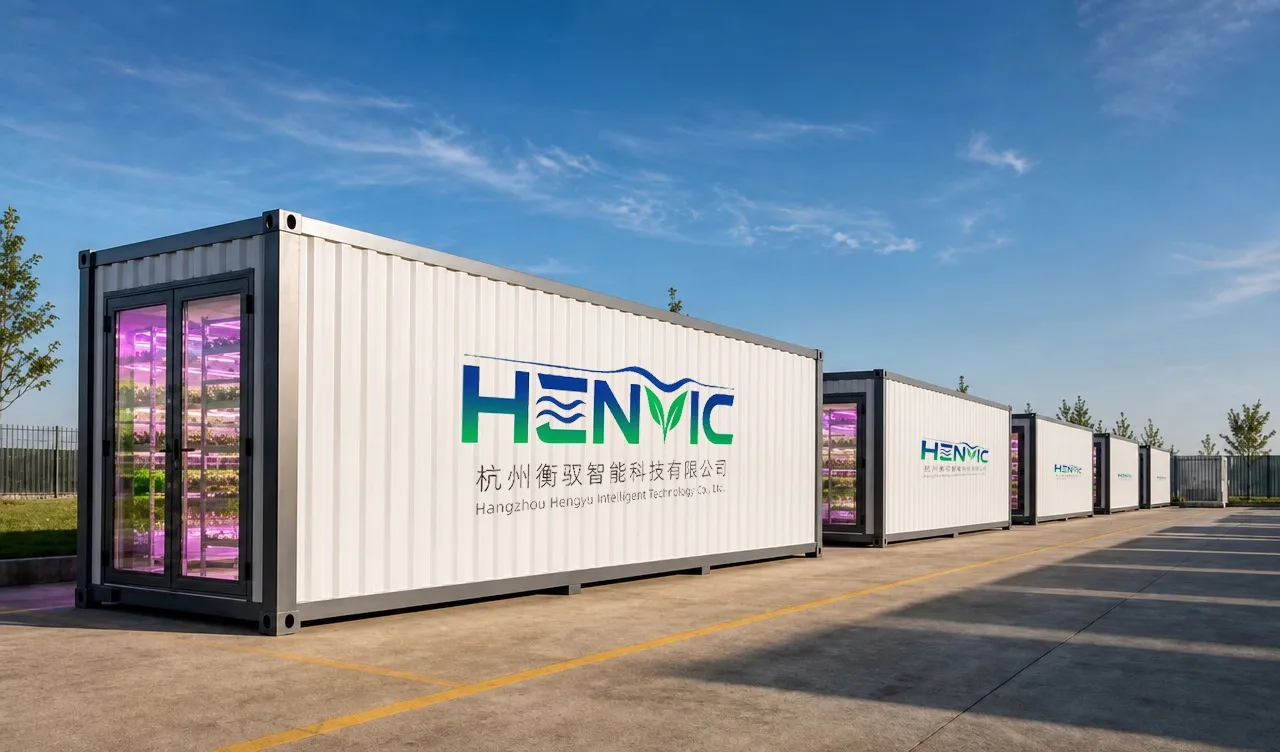
Step into a working container farm and the first thing you notice is not the plants. It is the air—cool, moving, and oddly consistent. That consistency is the product of the least visible and most demanding engineering in the system: climate control.
A container presents a brutal thermal environment. Steel walls conduct heat almost effortlessly, surface-area-to-volume ratio is high, and there is no thermal mass to buffer change. Outside temperature swings that a greenhouse would absorb must be actively countered. The result is that HVAC in a container farm is not a supporting system; it is often the primary load.
Four variables must be held in a shared equilibrium. Temperature affects growth rate, enzyme activity, and the balance between photosynthesis and respiration. Relative humidity governs transpiration and, critically, the risk of condensation on leaves—a standing invitation to fungal disease. CO₂ concentration can be enriched to 800–1,200 ppm to raise photosynthetic rate, but only if the box is sealed and the gas is not simply vented away. Air velocity distributes all of the above and prevents the microclimates that form around dense canopies.
The couplings between these variables are what make control difficult. Cooling air removes moisture, so temperature control is simultaneously humidification control. Sealing the box to retain CO₂ also traps heat and humidity. Raising airflow improves uniformity but increases evaporative demand and fan power. Add the heat output of LED fixtures and you have a system where adjusting one setpoint perturbs the others.
Vertical stacking compounds the challenge. Multi-tier racks place heat sources above plant canopies and obstruct airflow, creating vertical temperature and humidity gradients. Without deliberate ducting or per-tier air handling, the top tier may run several degrees warmer than the bottom, and the resulting crop variability undermines the uniformity that container farming is supposed to deliver.
The energy implication is severe. Cooling, dehumidification, and fan operation together can account for the majority of a facility's electricity consumption—frequently more than lighting, depending on climate. This is why container farms perform very differently in different latitudes and why insulation quality, air-sealing, and air-curtain design at doorways are disproportionately important. A well-insulated box in a temperate climate may consume a third of what a poorly sealed unit consumes in the same location.
The technology trajectory points toward integrated, model-based control. Instead of independent loops for temperature and humidity, modern systems use psychrometric models to coordinate them, and increasingly deploy machine learning to predict load from weather forecasts and tariff schedules. The goal is not merely to hold setpoints but to achieve them at minimum energy—trading a little environmental deviation for a large reduction in cost, where the crop tolerates it.
Climate control in a container farm is invisible when it works and catastrophic when it fails. It is also, more than any other subsystem, where the difference between a profitable installation and an expensive experiment is decided.